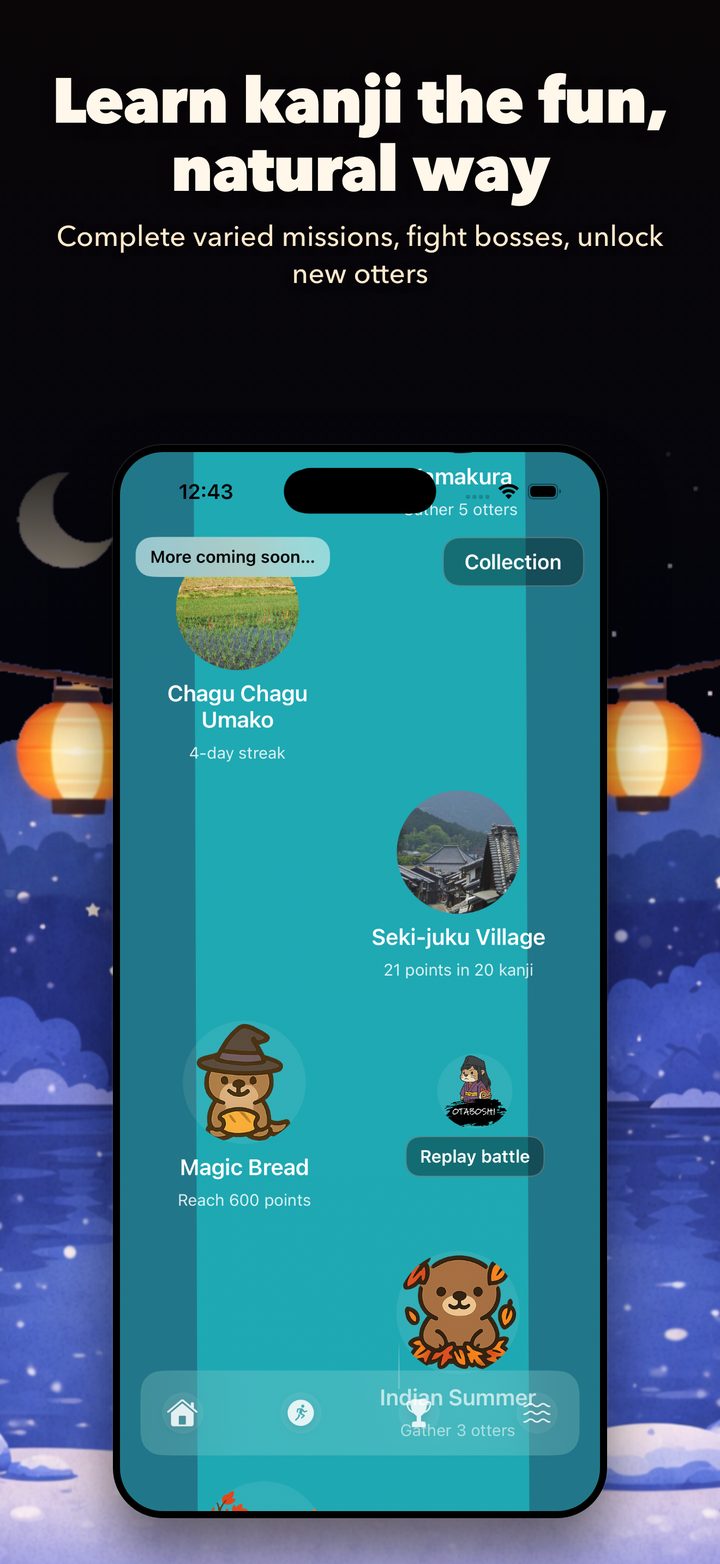
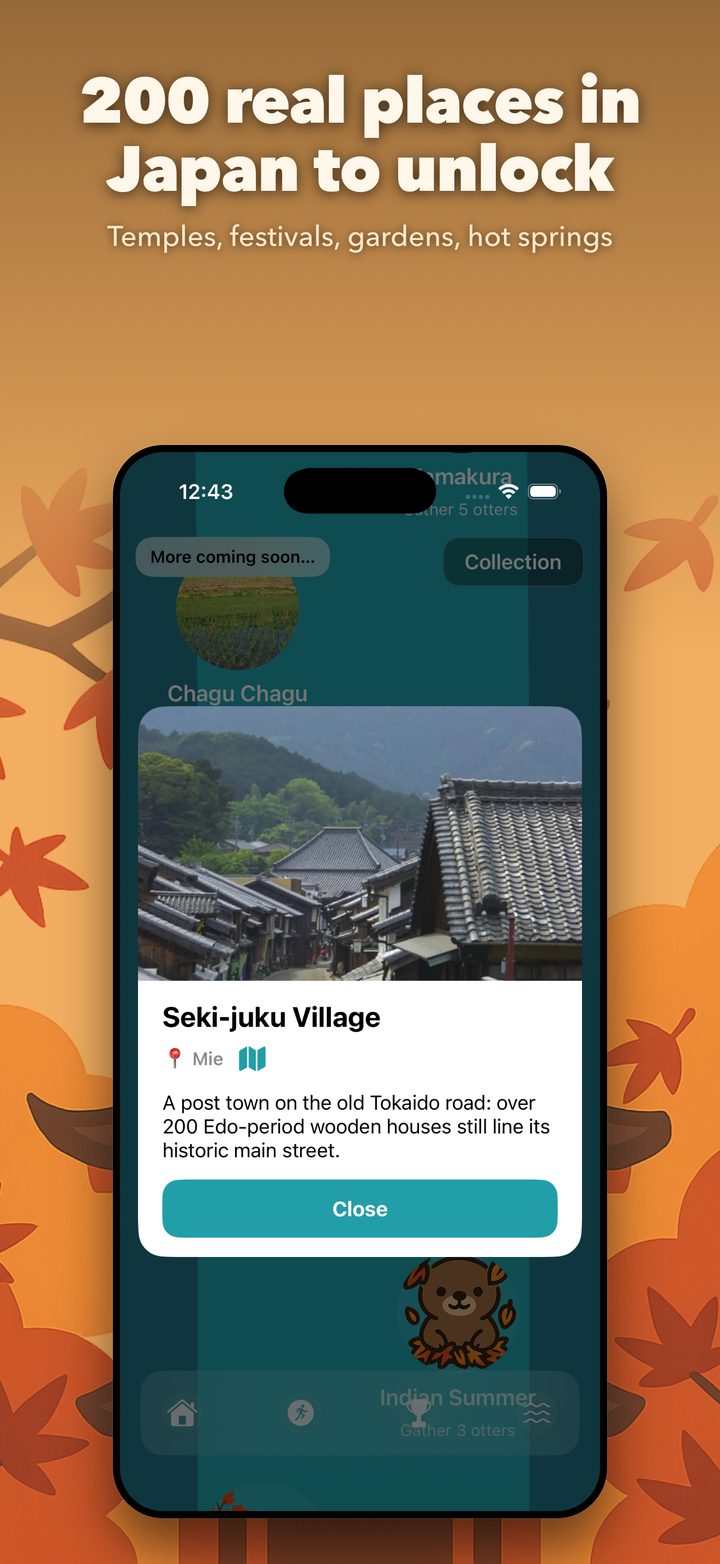
Guide your otter along the river all the way to the sea. Master all JLPT levels (N5→N1) through daily challenges, boss fights, and beautiful seasonal worlds.
The otters await!


270 progressive river stages. Unlock beautiful seasonal backgrounds and animations.
Face powerful bosses in kanji battles. Uncover the story behind the river journey.
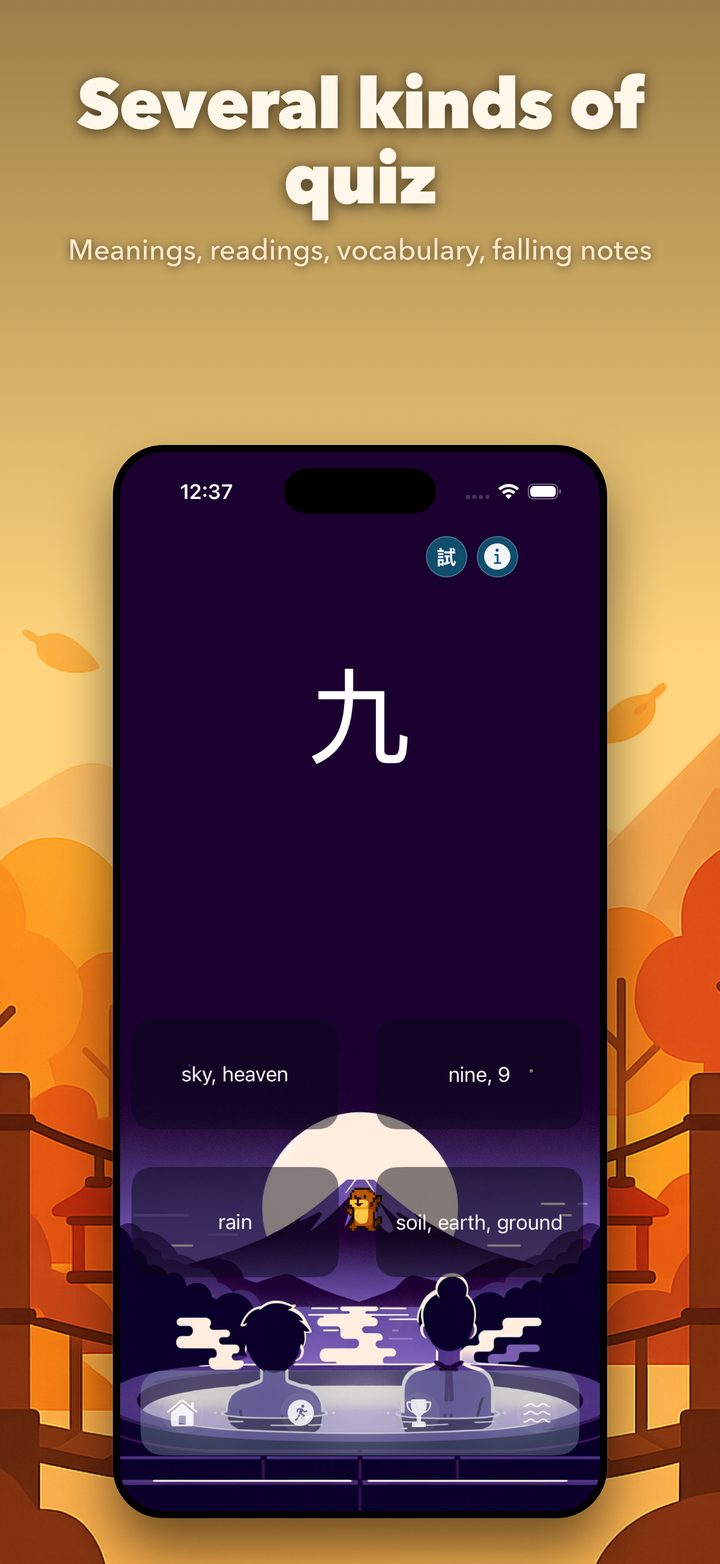
Reading, writing, matching, rhythm, multiple types to reinforce memory.
Unlock wallpapers, crowns and animations. Personalize your otter.
Compare with learners worldwide. Compete with friends and climb the ranks.
Track daily streaks and validate study days. Consistency beats intensity.
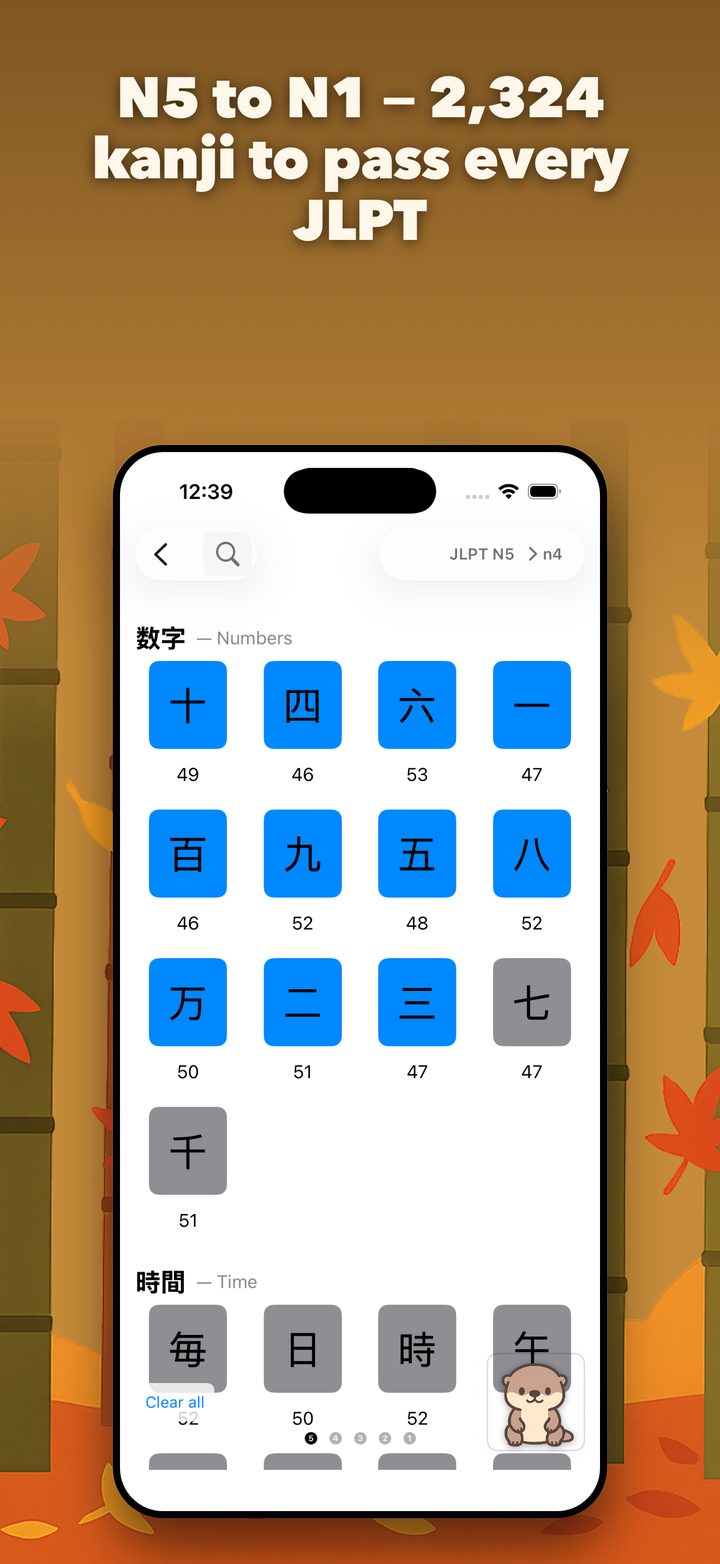
Browse and handpick kanji from all 5 JLPT levels (N5 to N1). Build your own study list and learn exactly what you want, at your own pace.
Learn Japanese in your native language
Get notified about new features and updates.
Leave your email to be notified at launch.
Bug, suggestion, question? We read everything at rt9app@gmail.com
Last updated: August 2026
JLPT Kanji Otter Adventure ("the App") is developed by Simon Depussay. This Privacy Policy explains what information the App handles, and why.
Your progress, scores and preferences, such as selected kanji, streak count, cosmetics and review schedule, are stored locally on your device. We never receive this data.
If you choose to take part in the global leaderboard, the App sends the username you picked and your score to Firebase Firestore (Google). Nothing else is sent. Please avoid using your real name if you prefer to stay anonymous.
The App uses Firebase Analytics (Google) to understand how it is used overall, for example how often it is opened. A random identifier is created on first launch. It is not linked to your name or your email address.
The free version offers rewarded video ads, which you choose to watch in exchange for extra practice. These ads are served by Google AdMob. To show ads that are relevant to you, AdMob may use your device advertising identifier and information about the ads you interact with.
On iOS we ask your permission before that identifier is used. If you decline, ads still work but are no longer personalised. You can change your mind at any time in Settings, Privacy & Security, Tracking.
Subscribers and lifetime owners never see any ads.
Purchases and subscriptions are handled entirely by Apple. We never see your payment details. Subscriptions renew automatically unless cancelled at least 24 hours before the end of the current period, from your App Store account settings.
Refuse tracking in Settings, Privacy & Security, Tracking. Remove ads entirely by subscribing or buying lifetime access. Stay off the leaderboard by simply not joining it. Delete everything by uninstalling the App, which removes all local data.
The App is not directed at children under 13. Because it displays third-party advertising, we ask parents to supervise its use by younger children.
Google, for Firebase and AdMob: policies.google.com/privacy. Apple, for purchases: apple.com/legal/privacy.
For any question about this Privacy Policy, contact us at rt9app@gmail.com.
We may update this Privacy Policy from time to time. Changes will be posted on this page with an updated date.
Three things work, and nothing replaces them. First, regularity: fifteen minutes every day beats two hours on Sunday, because memory is built by spaced repetition, not by blocks. Second, order: follow the JLPT levels from N5 to N1 rather than picking at random, since frequent kanji are the building blocks of the rest. Third, context: a kanji on its own is forgotten, a kanji seen in a word and a sentence stays. Copying a character a hundred times is the slowest method there is. Kanji Otter applies all three: level by level progression, automatic spaced review, and a translated example word for every kanji.
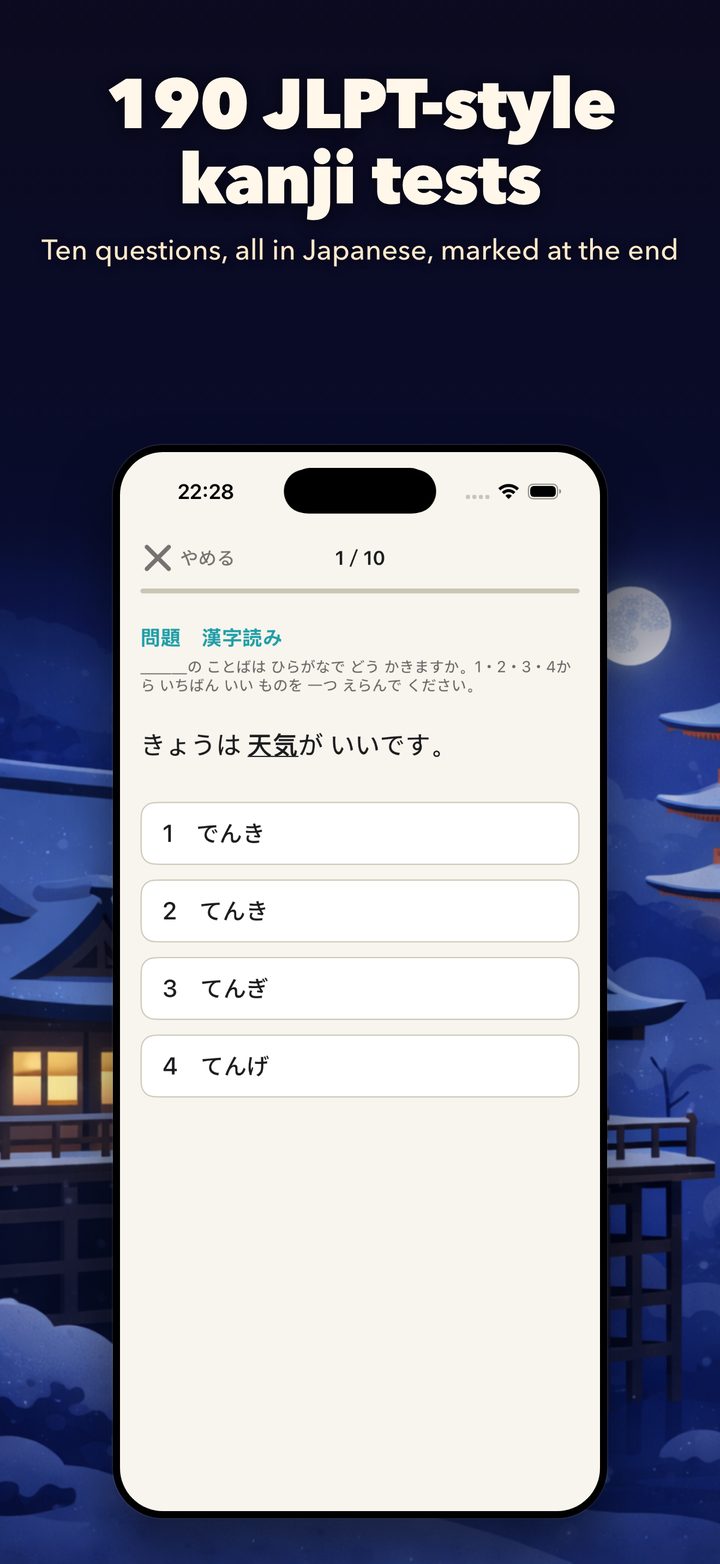
The exam has three sections: vocabulary and kanji, grammar and reading, listening. Each has a minimum score, so a strong section does not rescue a weak one: work on your lowest first. Kanji is not a separate section, it underpins the first two — without it you spend the exam decoding instead of understanding. Allow roughly six months between levels if you are consistent. And take timed mock tests: many candidates fail on time, not on knowledge. Kanji Otter includes 190 JLPT-style tests, entirely in Japanese, marked at the end.
Yes, and they serve a real purpose: what defeats most learners is not difficulty, it is giving up. A game gives you a reason to come back tomorrow. Be wary of apps where the game replaces the learning, though: collecting points without ever revisiting a forgotten kanji leads nowhere. The right balance pairs a motivating progression with genuine spaced repetition running underneath. Kanji Otter takes that angle: you sail up a river across Japan, every step you clear reveals a real place, and kanji you have already seen come back on their own.
As an order of magnitude: about 80 kanji for N5, 170 for N4, 370 for N3, another 350 for N2 and close to 1,400 for N1, so roughly 2,300 in total. The JLPT has not published an official list since 2010, so these are widely shared usage breakdowns rather than official counts. What matters is the shape of the curve: N5 and N4 take a few months, while N1 alone is more than half the journey. Kanji Otter covers all 2,324 kanji across the five levels.
You can, and you probably should if English is not your language. Translating mentally from Japanese to English and then to your own language adds a step to every word, slows your reading and tires you out. Yet most kanji dictionaries are English only. Kanji Otter shows meanings, readings and example words in six languages: English, French, Spanish, Vietnamese, Thai and Indonesian.
Repetition is essential: answer as many questions as possible in Learn Mode. To start, select kanji, then complete the challenges shown in the River section. Once you earn 50 points on a kanji, deselect it in the dictionary and start SRS mode to review it over the long term.
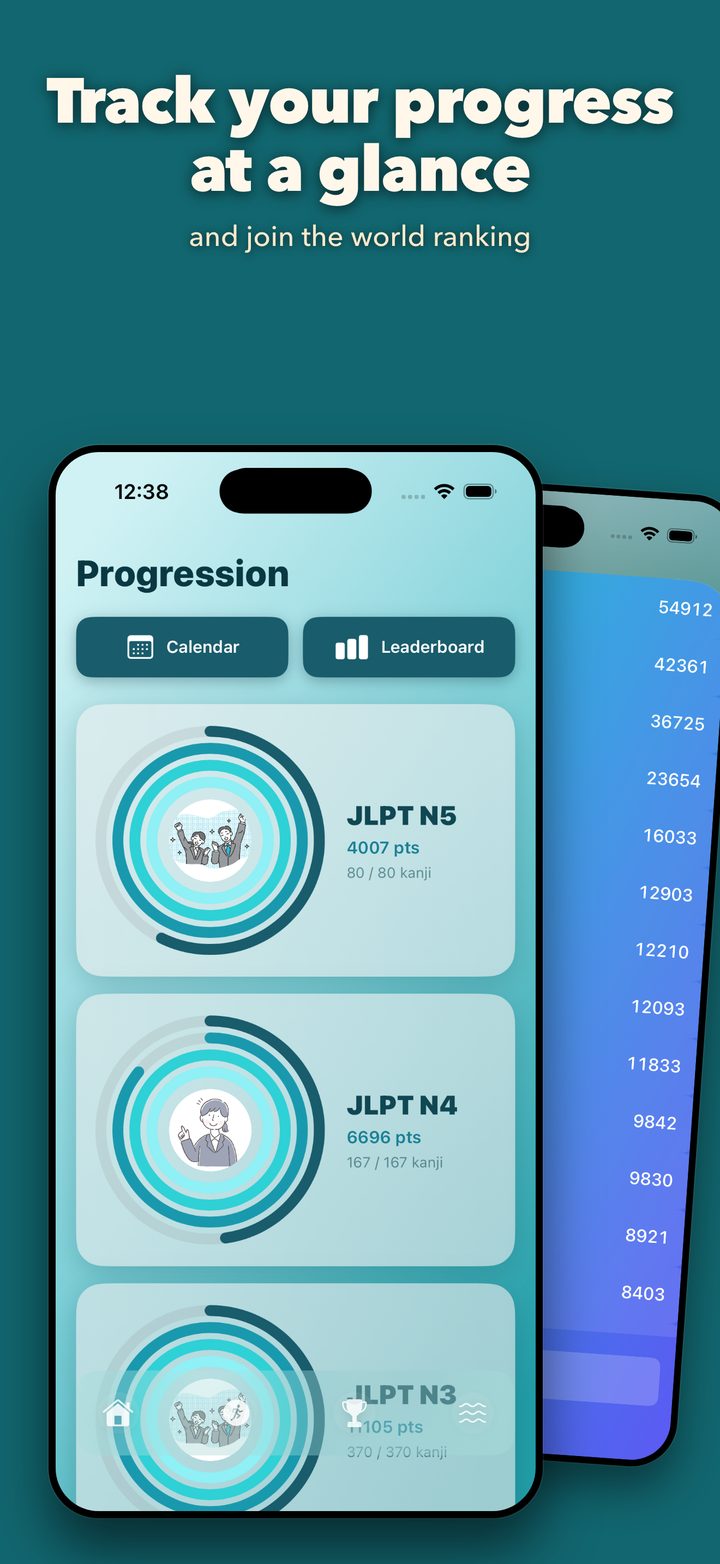
Each answer in Learn Mode earns points for each kanji. In the dictionary, under each kanji, you can see its total points. In the “Trophy” menu, you can track your overall progress by JLPT level. Try to reach the end of the river too.
The leaderboard shows the sum of all your points. Your score appears automatically on the “Leaderboard” page.
Select a reasonable number of kanji. In general, do not remove a kanji before reaching 50 points on it, but keep adding new kanji regularly.
There is nothing left to unlock: all five levels, N5 to N1, are freely available in the dictionary. Even if you do not plan to take the JLPT, these kanji are useful basics for reading Japanese.
The 試 button at the top of the main screen opens the exam mode. Pick a level, from N5 to N1, then a test: ten questions taken from the kanji part of a JLPT-style test, entirely in Japanese. There is no feedback during the test — your answers are marked at the end, with the correct answer for each question. These tests are separate from the river: they earn no points and no streak, only your best score is kept. The first test of each level is free; the other 185 require the subscription.
The free plan includes 25 answers in Learn Mode and 30 kanji in Quick Revision. Both counters refill completely every 5 hours, and a countdown shows the time left. You can also watch an ad to get half a quota back straight away, up to three times per refill. Boss fights, SRS mode, the river, the tourist spots and the dictionary are never limited.
The subscription removes both limits, opens all 190 kanji tests and takes away every ad. It comes as 1 month, 3 months or 1 year, each with a free week: the first charge only happens on the eighth day, and you can cancel before then from your App Store settings. A lifetime option is also available as a one-time payment. If you had already bought the level unlock, it counts as lifetime access, so there is nothing to buy again.
Some example words carry a note. « (name) » marks a proper noun — a city, a region or a surname: you learn its reading, but it is not everyday vocabulary. « Old spelling of … » marks an outdated spelling and shows you the form used today: 文藝 is now written 文芸. These words stay in the app because a few rare kanji hardly appear anywhere else.
Many features are still in development! Send us an email through “Contact” if you have a suggestion, an idea, or if you found a bug.